
Sites & Departments
Sites and Departments are used to organise assets, people, and maintenance activities into logical management areas. This structure allows you to align maintenance operations with how your business is organised in the real world.
For example, a large organisation may have multiple mine sites, plants, or facilities. Within each site, departments such as Mobile Equipment, Infrastructure, or Processing Plant can be created to group related assets and teams. This makes it easier to plan work, allocate responsibility, and report on performance at the level that makes sense for your operation.
Why Sites and Departments Matter
Grouping assets and personnel into sites and departments provides several benefits:
Improved visibility: View and manage assets, work orders, and performance indicators for each site or department. Accountability: Assign supervisors and technicians to specific areas, ensuring clear ownership of maintenance outcomes. Performance tracking: Generate reports and KPIs based on sites or departments to assess performance, utilisation, and reliability. Operational alignment: Match your maintenance structure to your organisational or geographic setup for smoother communication and control.
Example
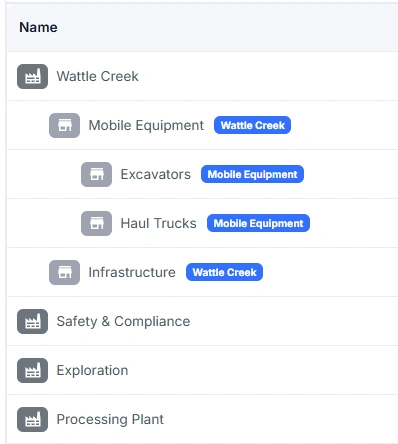
In the example above, Wattle Creek is a site containing several departments:
- Mobile Equipment (includes Excavators and Haul Trucks)
- Infrastructure
For this client, managing all excavators together under Mobile Equipment allows for focused maintenance planning, resource allocation, and performance reporting for that department. Supervisors and technicians can be assigned specifically to the Mobile Equipment group, with their performance measured using departmental KPIs.
Different organisations will use sites and departments according to their operational priorities. A manufacturing client may group by Production Line, while a council may group by Region or Service Type.
Best Practice
- Create sites that reflect physical locations or major operational areas.
- Create departments that reflect functional groupings within each site.
- Assign assets, tasks, and people to the appropriate department for accurate tracking.
- Use departmental KPIs to measure productivity, cost efficiency, and reliability at a manageable level of detail.